
- Overview
- CYDRP
- First Nations Advisory Group
- Data assets
- Research streams and publications
- Current projects
- Resources
The SCAFOLD (Strengthening Children and Family Outcomes using Linked Data) group at the Centre for Child Development and Education (CCDE) focuses on research using linked data to better understand and improve health, educational and social outcomes for Northern Territory (NT) children, young people and their families.
Information about many of our life experiences, from birth through to death are recorded by government agencies, services and programs in a wide range of administrative datasets. Data linkage is a method for reliably identifying and combining records for individuals across these whole-population administrative datasets to conduct research that would otherwise be impractical or impossible. It enables inclusion of harder to reach, vulnerable groups such as children in the care or justice systems with minimal risks to privacy. Strict security processes for accessing and using the data ensures privacy and safety of individuals and communities is maintained. Research using linked data is one of the safest and most cost-effective ways to produce high quality population-level evidence to inform improved targeting of interventions, evidence-based policy, and equity in child outcomes.
Over the last 15 years, research in the Centre has used linked data to produce high quality, locally relevant evidence on risk and protective factors across the life course, supported investments in early childhood, evaluated welfare programs, and informed key policy and system reforms, such as the recommendations from the Royal Commission into the Protection and Detention of Children.
Central to much the program of research undertaken by SCAFOLD is the Child and Youth Development Research Partnership (CYDRP), a strategic research partnership between Menzies and the NT Government that supports the development, management, and use of whole-population linked data assets to investigate a range of outcomes for NT children and families. This program of research is supported by the First Nations Advisory Group who help us ensure principles of Indigenous Data Sovereignty (ID-SOV) are applied to all aspects of our work.
Our current linked data asset, Extract 3, supports research across several themes and is supported by a comprehensive set of governance arrangements and processes that ensures use of the data not only satisfies our aims of improving outcomes for children and families but produces scientifically rigorous evidence that is relevant to policy-makers and communities.
For more information about linked data research please contact:
The Child and Youth Development Research Partnership (CYDRP) is a strategic research partnership between Menzies and the NT Government to support the use of whole-population linked data to conduct research and evaluation to improve child and youth wellbeing. Starting from an early demonstration project in 2009 which linked records from health and education agencies, our program of research using linked data has expanded under CYDRP to also include data from justice, child protection and social sectors.
The objectives of CYDRP are to:
- Support research that informs policy and program development in the areas of child development, family support, education, training and the wellbeing of children and young people.
- Evaluate strategies and programs for child and youth health, education and wellbeing and family functioning in the Northern Territory.
- Support the more general development of NT capability in advanced analytics and use of big data.
- Maintain and continue to expand and develop data assets that enable detailed research into child and family outcomes.
The CYDRP Steering Committee is responsible for governance of the partnership. The Committee reviews and approves new research project proposals, provides oversight of existing research projects and supports research translation from projects using CYDRP data assets.
CYDRP Steering Committee has representatives of:
- Attorney-General’s Department
- Department of the Chief Minister and Cabinet
- Department of Children and Families (Chair)
- Department of Corrections
- Department of Education and Training
- Department of Health
- Department of Treasury and Finance
- NT Police
- Menzies School of Health Research
CYDRP is funded by the Northern Territory Government. Current funding is to 2029.
The First Nations Advisory Group (FNAG) plays a central role in ensuring research using CYDRP linked data assets properly considers the needs, concerns, and benefits to Aboriginal and/or Torres Strait Islander people and communities.
FNAG is made up of Aboriginal and or Torres Strait Islander people with expertise and experience in health and wellbeing, education, welfare, justice and broader social concerns of NT children, young people and their families.
All proposals for research projects seeking to use CYDRP linked data assets must be reviewed and approved by FNAG. FNAG considers the cultural safety of proposed research projects and ensures they apply principles of ID-SOV (Maiam nayri Wingara) across all aspects of research activity from conception to translation.
Current members:
Councillor Peter Pangquee (Chair)
Amanda Hart
Heather D’Antoine
Philip Brown
Shaleena Musk
Kylie Stothers
Vacant – seeking member from Central Australia
Since 2009, our team have regularly conducted new linkages to update the individuals and their records across available administrative data collections and to link to new data collections. Extract 3 is the current linked data asset supporting our program of research. Information about the data we hold, how it is linked and managed, and how it can be accessed for research purposes is provided below. Information about the new linked data asset we are developing, Extract 4, is also provided below.
Researchers interested in working with our team to use CYDRP linked data assets should read the information below and discuss their ideas with the SCAFOLD research leader, Bernard Leckning. Proposals that meet the broad aims of CYDRP and are technically feasible will be supported to submit a detailed proposal through our online research register here.
CYDRP Extract 3
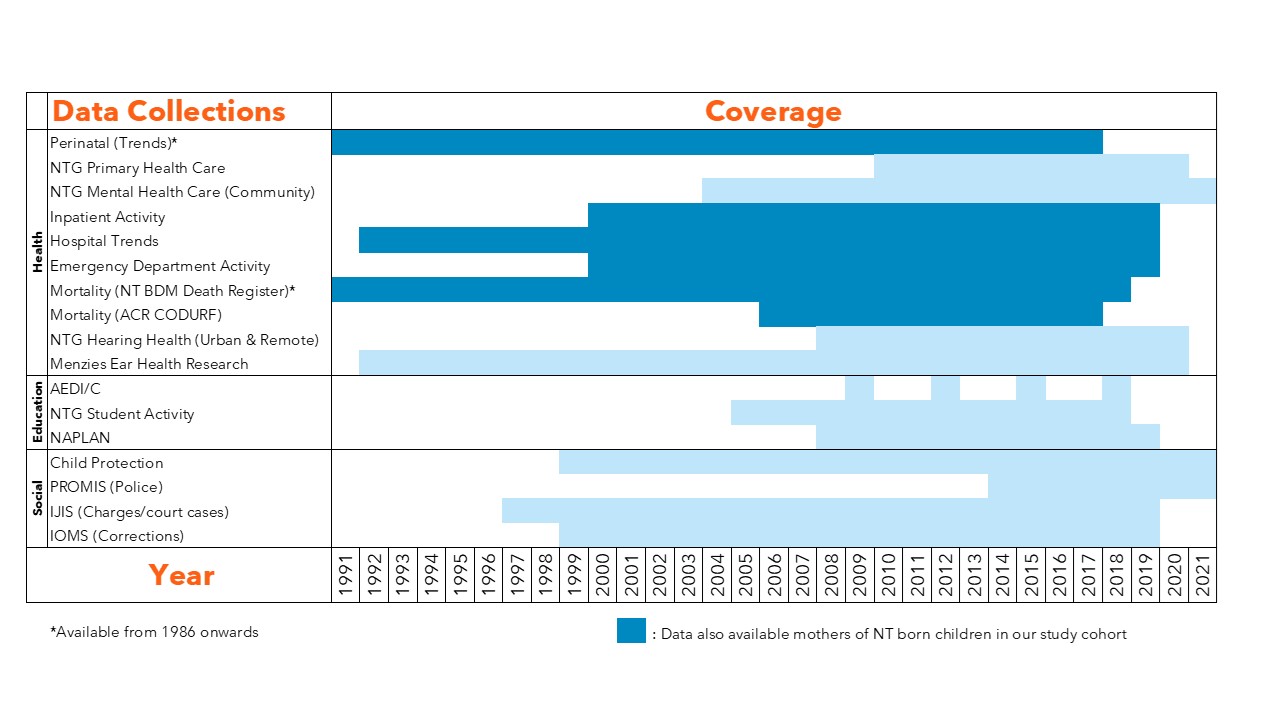
Extract 3 was brought online in 2021 and contains linked records for over 350,000 children born on 1 January 1986 onwards across 17 data collections. Some health records for the mothers of NT-born children were also linked and are available in Extract 3.
Linkage process and data flows
The linkage process for CYDRP data assets is facilitated and undertaken by SA NT DataLink, the authorised data integrating authority in the NT. This process is based on the ‘separation principle’ meaning that researchers never have access to people’s identifying information and owners of data being linked never see each other’s data.
The key steps in the linkage process are:
- Data Custodians securely send identifying information (e.g. names, date of birth, address) for each person in the CYDRP cohort to SA NT Datalink.
- SA NT Datalink generates anonymous ‘project specific linkage keys’ (PSLKs) for each person in the cohort and sends these PSLKs back to the Data Custodians.
- Data Custodians extract the content data requested for the CYDRP Extract (e.g hospital admissions, school attendance records etc), remove all identifying information in the records and replace it with the PSLKs. Data Custodians send the anonymised content data to SCAFOLD data managers via a secure research server.
- SCAFOLD data managers verify and check data quality, then create linkable datasets ready for research use.
Privacy and Data Security
A high-level of data security is implemented throughout all aspects of the development and use of CYDRP linked data assets. Processes and technologies to manage the storage, access and use of data have been designed around the Five Safes Framework:
- Safe settings: Data stored and analysed in a secure computing environment with audited and encrypted access (VPN).
- Safe people: Only approved investigators with relevant expertise can access the data for approved projects following training and signing of data governance documents.
- Safe data: All datasets fully de-identified; additional recoding (e.g., geographic data) to further reduce re-identification risk.
- Safe projects: CYDRP Steering Committee and FNAG review to ensure public benefit, appropriate use of the data, and culturally safe study designs.
- Safe outputs: Multi-stage screening by trained SCAFOLD Data Managers and relevant Data Custodians to ensure appropriate use of data and prevent re-identification risk prior to publication of research outputs.
CYDRP Extract 4
A new linked data asset, Extract 4, is currently under development. Extract 4 is expected to be available from early 2028.
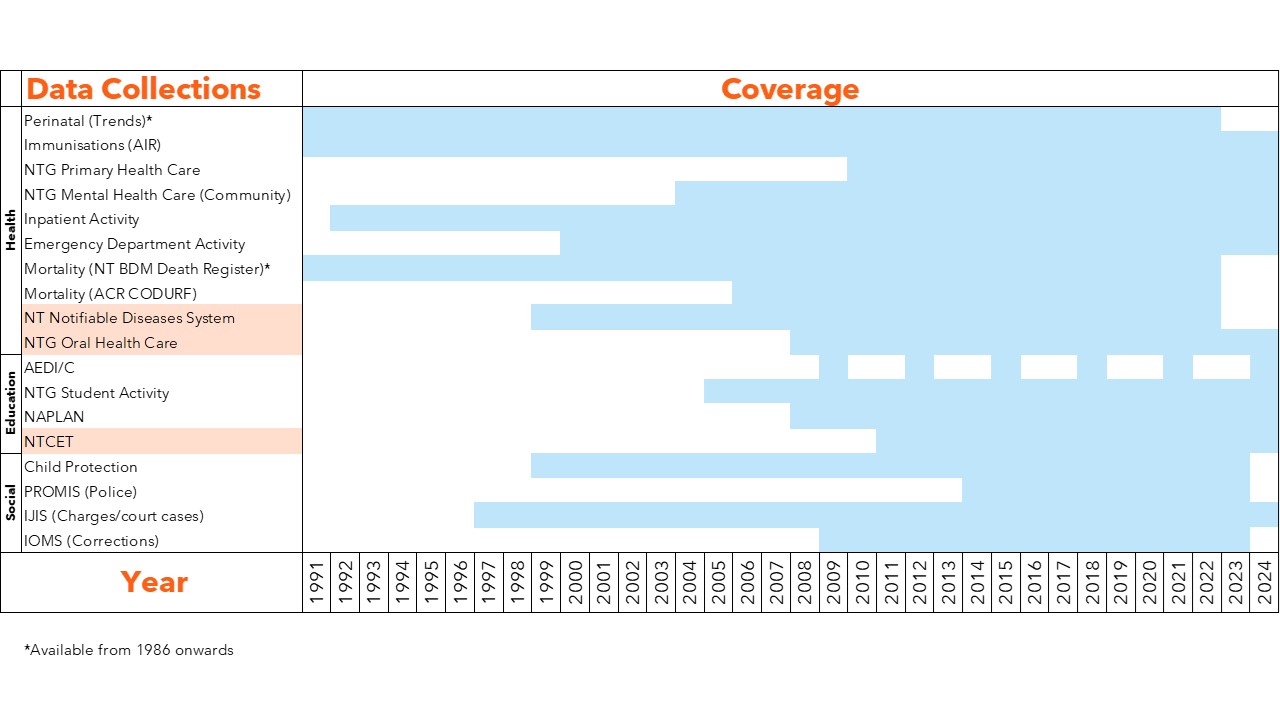
In addition to refreshing the individuals and data already linked in Extract 3, Extract 4 will:
- Extend the scope of family and intergenerational research by identifying and linking records for parents of NT-born children.
- Add new data collections (pending data custodian approval): socio-demographic and family linkage information from the NT Birth Register; dental health and service use from the NT Government Oral Health service records (Titanium); records of Year 12 achievement (NTCET); NT Notifiable Diseases Register
Child Development Research
Research in this stream focuses on retrospective cohort designs that explore health, education, protection, and justice outcomes over time using a range of statistical approaches to longitudinal analysis (e.g. Mixed-effects linear and logistic regression, survival analysis, structural equation modelling). See here for published examples of our work in this theme: https://www.zotero.org/groups/6107106/scafold/collections/WEG8W793
Systems Research
In this stream cross-sector service pathways and trajectories are mapped using a range of descriptive and statistical methods (e.g. cluster analysis, decision trees and random forests, Markov chain models and discrete event simulation). See here for published examples of our work in this theme: https://www.zotero.org/groups/6107106/scafold/collections/UJFXQENU
Evaluation Research
Quasi-experimental designs can assess the impact of historical policies, services, and programs using statistical models that support causal inference (e.g. Difference-in-differences, propensity score matching, instrumental variable analysis, and regression discontinuity). For a published example of our work in this theme, please see this paper: https://doi.org/10.1016/j.jhealeco.2022.102618
Machine Learning (ML) Research
This is an emerging stream of research focused on how novel ML techniques can be applied to a range of policy and research questions cutting across the other research themes. For a published example of our work in this theme, please see this paper: https://doi.org/10.1016/j.jhealeco.2022.102618
A full list of publications from our team can be found here.
Trajectories of youth re-offending: Exploring opportunities for intervention and prevention in the NT
Chief Investigator: Dr Bernard Leckning
This project will use linked administraive data to better understand how young people in the Northern Territory move through the youth justice system and why some continue to re-offend while others do not. It will identify common pathways of re-offending, work with experts and Aboriginal advisors to determine which pathways should be prioritised, and examine the health, mental health, child protection and social factors associated with them. The findings will help governments and service providers identify opportunities for earlier, more coordinated intervention, improve policies and programs to reduce re-offending, and support better outcomes for young people, particularly Aboriginal young people.
Aboriginal young people and the Northern Territory justice system: apprehension, caution, diversion, charge and detention
Chief Investigator: Dr Bernard Leckning
This project explores why Aboriginal young people in the Northern Territory are far more likely to be apprehended, charged, and sent to detention than non‑Aboriginal youth. Using linked data from police, courts, child protection, health and education—alongside interviews and policy review—the study examines how diversion programs are used, who receives them, and what barriers exist. The aim is to understand why diversion has not delivered lasting improvements for Aboriginal young people and to identify practical changes that could make the justice system fairer, more effective and better aligned with community needs.
From Preschool to Year 3: School engagement of NT remote children
Chief Investigator: Dr Georgie Nutton
This project explores why many children in remote Northern Territory communities appear in Transition but are missing from Year 3 NAPLAN records. Using linked education, health and social datasets, the study identifies how many children do not reach the Year 3 assessment point and what factors—such as attendance, development, health or family circumstances—are linked to staying engaged in school. The aim is to understand early patterns of disengagement so schools and policymakers can better support children through the crucial early years of learning, ensuring the benefits of preschool continue into primary school.
Youth in Emergency Departments
Chief Investigator: Dr Bernard Leckning
This project examines why young people aged 12–17 in the Northern Territory attend emergency departments so often, and what their broader health, social and wellbeing needs look like. By linking hospital, education, child protection, justice and mental health records, the study identifies the characteristics of young people who present to ED – including those who attend frequently – and the factors driving these patterns. The findings will guide the design of a new youth‑focused model of care at Royal Darwin Hospital, helping ensure young people receive the right support at the right time and improving long‑term outcomes.
Examining the complex needs and behaviours of adolescents in out of home care (OOHC)
Chief investigator: Dr Bernard Leckning
Funding: NT Department of Children and Families
This study will use linked administrative data to better understand the needs and experiences of adolescents in out-of-home care in the Northern Territory. It will describe patterns of care, examine health, mental health, education and youth justice needs, identify groups of young people with similar support needs, and investigate factors that influence outcomes before, during and after care. The findings will help identify opportunities for earlier intervention, improve coordination between child protection, health, education and justice services, and inform policies and programs that strengthen support for adolescents in care, particularly Aboriginal young people, as they transition to adulthood.
Family violence by adolescents in the NT
Chief Investigator: Dr Hoang Phan
This project investigates why some adolescents in the Northern Territory use violence against family members and whether early exposure to domestic and family violence contributes to this behaviour. Using linked police, child protection and justice data, the study examines patterns of DFV in adolescence and the backgrounds of young people involved. The aim is to build evidence that helps policymakers design better responses and supports for families, and to guide strategies that prevent violence and improve safety and wellbeing for young people and their households.
Mental health care after self-harm hospitalisation among children and youth in the Northern Territory of Australia
Chief Investigator: Dr Bernard Leckning
This study will use linked administrative data to examine the mental health care received by Northern Territory children and young people after they are hospitalised for self-harm. It will describe the characteristics of young people admitted to hospital, compare the experiences of Aboriginal and non-Aboriginal adolescents, and identify factors associated with receiving timely community mental health follow-up. The findings will help identify gaps and barriers in aftercare, inform improvements to mental health services, and support more equitable, culturally appropriate follow-up care to reduce the risk of repeated self-harm and improve outcomes for vulnerable young people.
Profiles of early childhood adversity and their outcomes in middle childhood
Chief Investigator: Professor Gary Robinson
Menzies PhD Student: Samuel Gele
This study will determine if we can use routinely collected administrative data and machine learning (ML) techniques to identify patterns of early childhood adversity (ECA) and better understand how it affects children's health, development and education. ML will be used to develop profiles of ECA between birth and six years of age and examine how these profiles are associated with preventable hospital admissions, school attendance and academic achievement during middle childhood. The findings will help identify children most likely to benefit from early support, improve coordination between health, education and child protection services, and inform policies that promote healthier developmental pathways, particularly for Aboriginal children and families.
Patterns of public community-based mental health service use and outcomes among children and adolescents in the Northern Territory: A whole-population data linkage study
Chief Investigator: Dr Bernard Leckning
Menzies PhD Student: Sintayehu Alemayhu
This study will use linked government data to understand how children and adolescents in the Northern Territory use public community-based mental health services and what influences their outcomes. It will examine patterns of service use, identify factors associated with successful and unsuccessful treatment, and investigate which young people are most likely to require emergency department or hospital care after leaving mental health services. By exploring links with education, child protection, physical health and youth justice, the research will provide evidence to improve service planning, support earlier intervention, and strengthen culturally safe, effective mental health care, particularly for Aboriginal children and adolescents.
The trends and effects of prenatal alcohol use on birth, development, and educational outcomes: a Longitudinal Data analysis of mothers and children in the Northern Territory, Australia
Chief Investigator: Professor Steve Guthridge
Menzies PhD Student: Behailu Derseh
This project investigates how common alcohol use during pregnancy is in the Northern Territory and how it affects children’s health, development and learning. Using long‑term linked data, the study follows mothers and their children from birth through early schooling to see whether alcohol exposure in pregnancy is linked to problems such as low birth weight, developmental delays or poorer academic performance. It also tracks trends in alcohol use over time. The goal is to provide evidence that helps improve prevention, support and services for NT families, leading to healthier pregnancies and better outcomes for children.
Maternal mental health-related hospitalisation (MHrH) in the first postnatal year and its effect on child outcomes in the Northern Territory (NT) of Australia
Chief Investigator: Professor Steve Guthridge
Menzies PhD Student: Demeke Belay
Maternal mental health problems sometimes lead to hospitalisation in the year after childbirth. This project studies how often that happens for Northern Territory mothers and whether it affects their children’s health, safety, development and schooling. Using linked NT datasets, the research follows children from birth through early school years to see if those whose mothers were hospitalised face higher risks – such as illness, child protection involvement, developmental vulnerability or poorer attendance and learning. The aim is to provide evidence that helps improve support for mothers and better outcomes for NT children.
Does otitis media increase the risk of conductive hearing loss in Aboriginal children living in the Northern Territory?
Chief Investigator: Dr Jiunn-Yih Su
This project examines whether common ear infections in early childhood lead to hearing loss among Aboriginal children in the Northern Territory. By linking clinical ear health records with hearing test results, the study compares children diagnosed with different types of otitis media to those without these conditions to see who is most at risk of mild or more serious hearing loss. The aim is to provide evidence that helps clinicians identify children who need early referral and treatment, improving language development and long term learning outcomes for children in remote and urban NT communities.
- Protection and Justice: A study of the crossover of Northern Territory children between two services. (2019)
- From Birth to Five: A multiagency data-linkage study to inform a public health response to child protection in the Northern Territory. (2019)
- Exploring risk profiles of young people with self-harm hospital admissions in the Northern Territory. (2019)